

What is Cross-Brand SEO and How It Works
To successfully execute this strategy, one must first look beneath the surface of traditional search engine optimization. It requires a shift from managing isolated keywords to orchestrating a synchronized network of digital assets that look entirely independent to the outside world. Let’s break down how this structural framework operates in practice and when your business should make the leap.
The Core of the Approach and How It Differs from Promoting a Single Casino
In the highly competitive digital gambling landscape, relying on a single web resource is a high-risk strategy. Cross-brand SEO involves building, optimizing, and promoting a diversified network of independent web assets targeting the same niche but operating under different brand names, designs, and positioning. While single-site promotion focuses all resources, backlinks, and content optimization on one domain, a cross-brand strategy spreads presence across multiple properties.
Working with an experienced igaming SEO company allows operators to scale horizontal coverage. Instead of trying to squeeze more traffic out of a saturated single site, you build multiple funnels. By trusting this process to dedicated igaming SEO experts, you ensure that internal insights and traffic loops are shared seamlessly across your assets while your external rivals are systematically pushed down. The core differences between these two strategic models are summarized below:
| Feature | Single-Site Strategy | Cross-Brand Network Strategy |
|---|---|---|
| Risk Distribution | High — a single algorithm penalty can halt organic acquisition completely. | Low — traffic is distributed across independent domains, mitigating system-wide drops. |
| SERP Footprint | Maximum of 1 ranking position per keyword intent. | Multiple ranking positions (3–5 spots) for the same commercial intent. |
| Audience Reach | Limited to a single brand identity and user preference model. | Segmented across different player types (e.g., VIPs, crypto users, casual players). |
| Resource Allocation | Concentrated on continuous, incremental optimization of one domain. | Distributed across parallel development paths and niche-specific satellite sites. |
When a Company Outgrows a Single Website and It’s Time to Launch a Brand Network
Transitioning from a single project to a multi-site infrastructure becomes necessary when user acquisition costs through standard channels begin to plateau. If your main domain occupies stable positions in the TOP 5 for core transactional keywords but traffic growth has slowed down, you have hit the ceiling of a single domain’s organic capacity.
It is time to launch a brand network when:
- Market Saturated: Your main site ranks high, but keyword volume caps prevent further traffic growth on that domain.
- Audience Segmentation Needed: You need to target distinct player personas (e.g., high-stakes table players vs. casual bonus-hunters) without diluting your primary brand’s positioning.
- Geographical Expansion: Entering new jurisdictions that require completely localized compliance structures, payment options, and distinct user experiences.
- Search Intent Capturing: You want to target comparison-seeking users who type terms like “Brand A vs Brand B” or “Top 10 alternate casinos”.
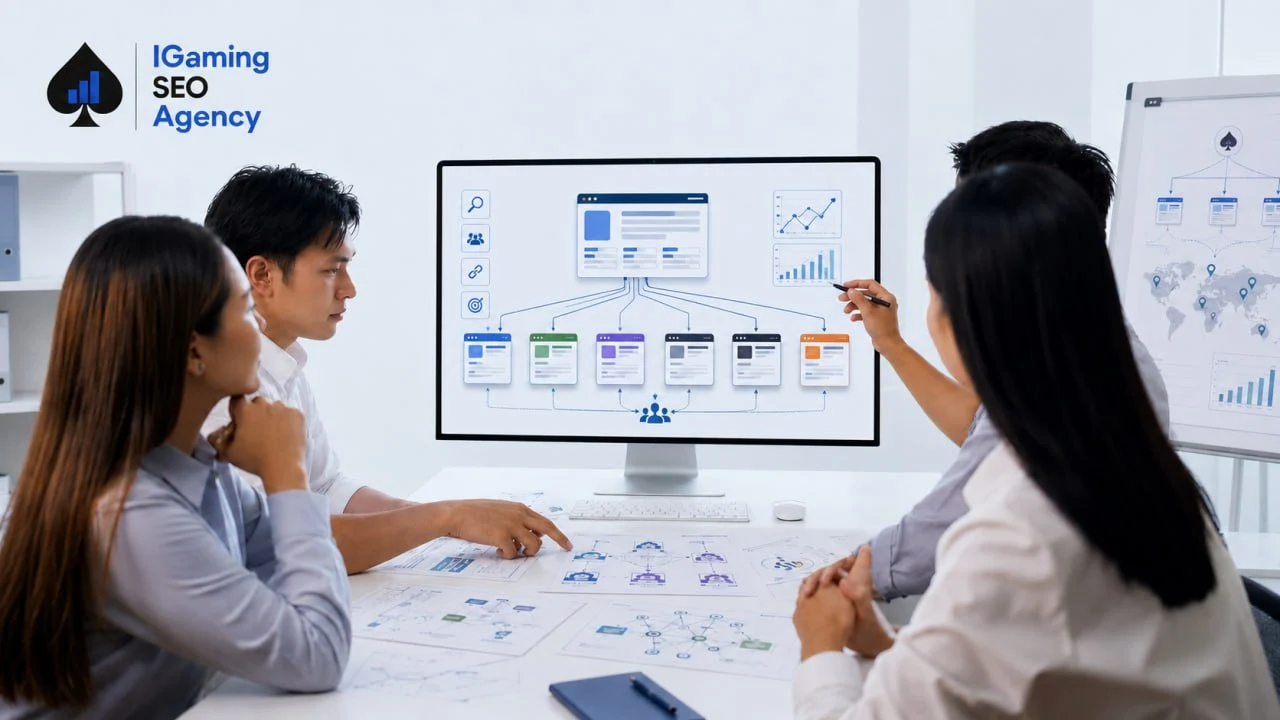
Why Gambling Companies Should Implement Cross-Brand Strategies
Deploying a multi-site network is not just a defensive measure against volatile search algorithms; it is an aggressive growth strategy designed to maximize your digital footprint. For ambitious operators, moving beyond a single domain unlocks powerful competitive advantages that directly impact the bottom line. Let’s look at the primary operational and strategic reasons why leading brands are adopting this multi-faceted model.
Dominating the SERP: How to Take Multiple Spots in the TOP 10 and Push Competitors Out of Search
The ultimate goal of organic optimization is real estate ownership in search engine results pages. When a user searches for competitive commercial terms, search engines display ten organic results. If your company operates only one site, you can occupy at most one position. By deploying a sophisticated network managed by the igaming SEO agency, you can occupy three, four, or even five spots in that same TOP 10.
This structural dominance dramatically changes the click-through-rate (CTR) dynamics. By capturing multiple search listings, you push direct market competitors down to lower positions or onto the second page, effectively cutting off their organic acquisition pipelines while multiplying your own chances of conversion.
Business Safety Net: What to Do If One of Your Websites Loses Traffic
Organic search is highly volatile. Sudden core algorithm updates, manual reviews, or localized regulatory blocks can drastically reduce a single domain’s visibility overnight. A cross-brand network serves as a critical structural safety net. If one platform suffers an algorithmic dip or a domain-level penalty, your remaining independent websites continue to rank, process traffic, and generate conversions.
Partnering with dedicated igaming SEO experts ensures that the network is structured resiliently, shielding the overarching corporate entity from devastating single-point-of-failure vulnerabilities:
- Algorithmic Cushion: If Site A drops by 40% in visibility during a product review update, Site B and Site C can capture that volatile traffic.
- Fast Recovery Buffering: While engineers remediate issues on an impacted domain, marketing operations continue uninterrupted via active nodes.
- Regulatory Isolation: If local ISPs block a single domain in a specific target country, alternative satellite domains keep processing local player sign-ups.
Reputation Management: How to Overwrite External Negative Content with Your Own Sites
In the betting and online casino niche, reputation management is a continuous challenge. Affiliates, forums, and review aggregators often publish negative user feedback or biased ratings that can damage brand perception. A cross-brand ecosystem provides an active mechanism for search engine reputation management (SERM).
By optimizing your secondary satellite sites for branded search terms and review-related queries, you can fill the search results for your main brand with controlled, objective, or highly favorable content from your own ecosystem. This pushes third-party negative reviews out of view, ensuring that prospective players encounter trustworthy information when researching your products.

Structural Models for Developing a Cross-Brand Website Network
Building a successful cross-brand network requires choosing the right structural format based on your business objectives and available resources. Depending on the target market, operators typically select one of three proven models:
- The Multi-Brand Casino Network: Launching independent casino brands, each with distinct gaming licenses, unique visual themes, separate loyalty programs, and individual bonus structures. They appear as separate entities to users and search engines alike.
- The Dedicated Affiliate/Review Infrastructure: Creating a network of high-authority review sites, comparison portals, and betting guides. These sites rank for valuable informational and transactional keywords, funneling high-intent traffic directly to your primary online casino properties.
- Localized Satellite Sites: Deploying highly targeted, geo-specific domains tailored to individual regional markets, cultures, and dialects. This strategy allows for precise local optimization without risking the authority of the main international domain.
Step-by-Step Plan: How to Correctly Grow a Cross-Brand Ecosystem
Building a multi-site network requires more than just buying domains and publishing content; it demands a rigorous, highly methodical technical blueprint. Without a clear deployment strategy, an ecosystem can easily crumble due to footprint leaks or internal competition. Below is the precise roadmap for scaling your digital assets securely, efficiently, and with maximum strategic impact.
How to Set Up Servers and Hosting So Google Doesn’t Connect Your Websites to Each Other
To ensure the long-term viability of a multi-brand strategy, search engine web crawlers must not easily associate your sites with one another through digital footprints. If search engines identify a hidden, low-quality network owned by a single entity designed solely to manipulate search, it can lead to cross-domain penalties. To execute this correctly, professional SEO for igaming mandates clean infrastructure separation:
- IP and ASN Diversity: Host websites across entirely different hosting providers, utilizing diverse C-class IP blocks and Autonomous System Numbers (ASNs).
- Different CDNs and DNS: Avoid using a single Cloudflare account with identical settings across all properties. Vary your DNS management providers.
- Clean WHOIS and Registration Data: Use privacy protection features, distinct corporate registration details, and separate domain registrars to eliminate explicit ownership patterns.
How to Divide Keywords So Your Projects Don’t Fight Each Other in the Search Results
A frequent error in multi-site management is keyword cannibalization, where your own domains actively compete against each other for the exact same search query. To prevent this internal friction, your keyword matrix must be systematically segmented. Each site within the ecosystem must target a distinct semantic cluster rather than targeting the same global list.
For a successful campaign, the Master Keyword Pool should be distributed across your network based on user intent and specific niches:
- Site 1 (High-Volume Core): Focuses on high-volume, highly competitive broad commercial keywords. Examples include “best online casinos” and “online slots“.
- Site 2 (Feature & Geo Long-Tail): Targets localized queries and specific user preferences. Examples include “fast payout casino uk” and “no wagering bonus“.
- Site 3 (Payment & Tech Specific): Captures alternative and modern gambling trends. Examples include “crypto casino btc” and “tether slot sites“.
This intentional semantic distribution allows you to cover 100% of the user’s search journey – from informational intent to high-intent transactional queries – without splitting the ranking signals of individual pages.
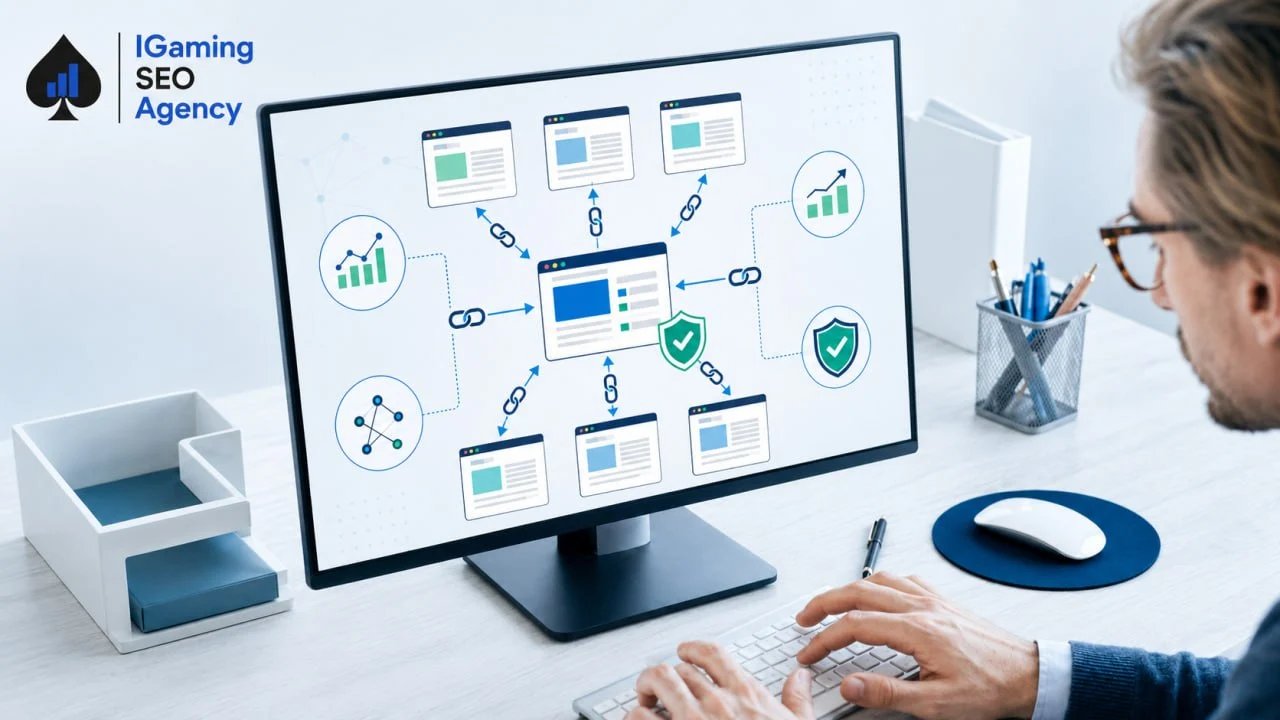
How to Safely Share Link Juice Within Your Own Website Network
Link building is a cornerstone of organic visibility, but internal cross-linking must be executed with extreme caution. Interlinking all your sites in a closed loop creates an obvious footprint that search engines easily detect.
- Asymmetrical Link Flows: Avoid reciprocal linking (Site A linking to Site B, and Site B linking back to Site A). Instead, pass authority linearly or dynamically via natural context.
- No Sitewide Footers: Never use global footer links or sidebar templates to connect your internal brands.
- Contextual & Editorial Links: Links should only flow naturally within high-quality content where it adds genuine value to the reader.
- Vary Anchor Text Profiles: Maintain a healthy, natural distribution of generic, branded, and long-tail exact-match anchors across the network.
Our Cross-Brand Case Studies and Work Results
Theory and technical blueprints are essential, but the true measure of a multi-site ecosystem lies in its real-world performance. Over the years, we have built, insulated, and scaled numerous brand networks, turning algorithmic volatility into predictable revenue streams for our clients. Below are three concrete examples of how our structured frameworks achieved market dominance, safe expansion, and traffic resilience in the toughest markets.

Case Study 1: Market Expansion via Localized Satellites
Expanding into unfamiliar jurisdictions often exposes an established gambling brand to unforeseen technical and regulatory hurdles. Managing these risks requires a strategic approach that localizes content while fully protecting corporate assets.
Challenge: A prominent international betting operator wanted to enter three highly competitive emerging regional markets without risking their primary, high-authority domain against sudden local regulatory shifts or potential algorithmic volatility.
Solution: We deployed an agile network of independent geo-specific satellite sites. Each domain featured localized content, custom UX patterns tailored to regional player preferences, and dedicated local hosting infrastructures.
Result: Within 7 months, the satellite network generated a steady stream of new depositing players, securing over 35% of target regional search visibility, all while keeping the primary domain completely isolated from new market entry risks.
Case Study 2: Capturing the TOP 5 in High-Competition Niches
When a search niche reaches its peak saturation, standard optimization methods on a single domain often yield diminishing returns. Breaking through this growth ceiling requires a multi-layered organic presence that captures different segments of the same search query.
Challenge: An operator sought to dominate a saturated slots-related niche where a single domain could no longer gain incremental traffic shares due to extreme competitor density.
Solution: As a specialized igaming SEO company, our team developed a comprehensive three-tier cross-brand strategy. We divided the high-value commercial keyword matrix among three distinct properties: one high-end premium casino brand, one crypto-centric casino platform, and one specialized review portal.
Result: By eliminating keyword cannibalization and building independent authority profiles, we successfully positioned all three properties within the TOP 5 for the primary commercial keywords, effectively locking out two major industry competitors.
Case Study 3: Traffic Insulation During Volatile Google Core Updates
Global algorithmic shifts can instantly wipe out years of organic growth if your entire digital asset portfolio shares identical technical footprints. Securing a high-volume traffic infrastructure requires proactive architectural decoupling to ensure that an issue on one domain does not trigger a network-wide collapse.
Challenge: A major gambling holding company wanted to protect its massive digital traffic footprint from the systemic volatility associated with global search engine algorithm updates.
Solution: Our expert igaming SEO company implemented a strict technical isolation protocol across their ecosystem, decoupling hosting environments, content management architectures, link-building profiles, and analytics tracking accounts.
Result: When a massive Google Core Update rolled out, impacting one of the network’s legacy domains, the other isolated platforms remained completely unaffected. In fact, two of the secondary brands saw increases in rankings, allowing the holding company to preserve over 80% of its aggregated organic traffic and revenue streams through the transition period.
Let’s Discuss the Growth Plan for Your Cross-Brand Website Network
Ready to scale your organic footprint, insulate your business from algorithmic risks, and dominate the search results? Leave a request below, and the iGaming SEO agency will analyze your current portfolio to design a secure, high-yield multi-brand SEO strategy.
Latest news & insights
Brand Protection in iGaming SEO Agency
Issues We Combat to Protect Your Organic Traffic Our iGaming brand protection work focuses on threats that can steal clicks, damage trust,…
Read more →Buy and Sale Affiliate Sites in iGaming
Why Buying an Existing Affiliate Site is Better Than Starting from Scratch Launching a fresh domain in the gambling or betting vertical…
Read more →Contacts
Direct channels to reach our SEO iGaming experts Fast communication matters in gambling search projects where rankings, indexing, content updates, or traffic…
Read more →iGaming LinkBuilding Services
Why Old Gambling Link-Building Methods No Longer Work Search engine algorithms have evolved past simple pattern recognition. The era of automated forum…
Read more →iGaming SEO Agency
What is an iGaming SEO Agency and How Does It Work? An agency in this niche works with online casinos, sportsbooks, affiliates,…
Read more →iGaming SEO Agency: Our Journey
Who We Are and Why We Chose the Casino and Betting Niche We are a search team focused on gambling websites where…
Read more →iGaming Traffic: How to Attract High-LTV Players
Traffic Sources in Gambling: SEO vs. Paid Ads Gambling brands usually compare SEO and paid ads by speed, cost, risk, and player…
Read more →Meet Our Team of iGaming SEO Experts
The People Who Help You Every Single Day A strong gambling project depends on specialists who handle different parts of search growth…
Read more →Technical Audit for iGaming Sites
What We Verify During a Technical Audit iGaming platforms frequently accumulate technical debt, resulting in indexation bloat, duplicate affiliate tracking parameters, and…
Read more →